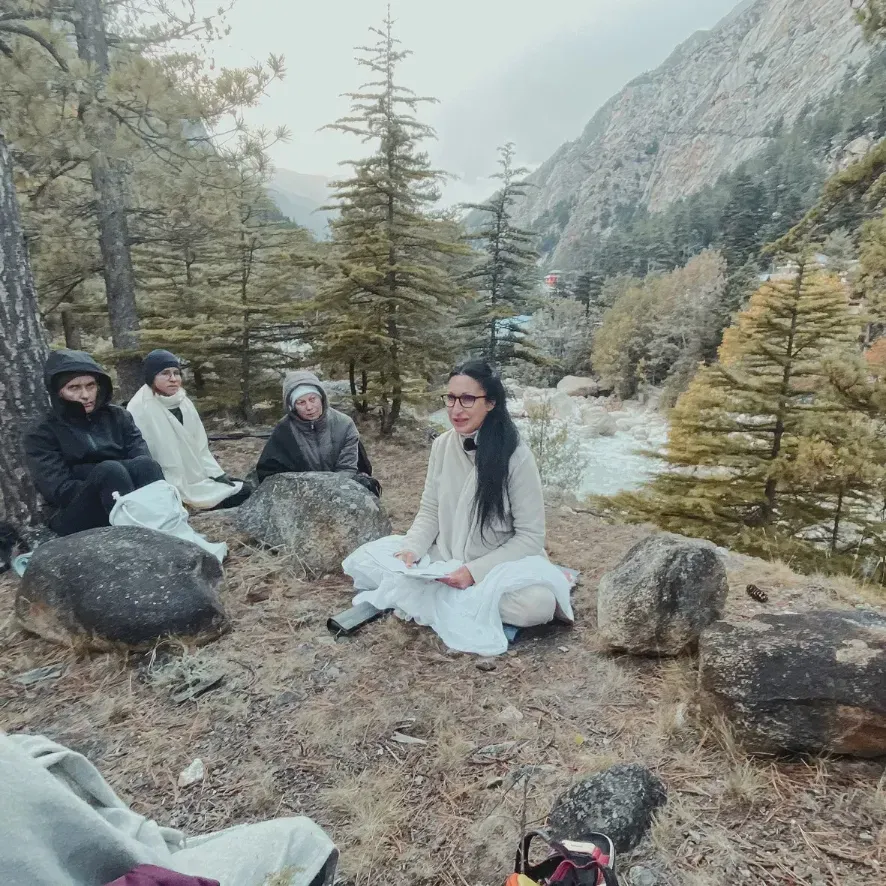

Satsang – a spiritual gathering
Even today, yogic teaching is passed on from Teacher to student directly.
It is a special and meaningful time, when the Teacher shares their spiritual knowledge and experience.
Through this living connection, called satsang, students have the chance to understand the practice, psychology and philosophy of yoga more deeply and to realise their true nature. It is not possible to grow spiritually without a true guide in yoga – a Teacher, a Guru. Only a true Teacher can pass on knowledge of what a person has not experienced, that is, of their deepest essence, the Self, and explain the obstacles and particulars of self-realisation.
What is satsang?
Satsang (satsaṅga): translated, “sat” means “truth” and “sanga” means “meeting, company, fellowship”. So “satsang” means “being in the truth” or “company with spiritual truth”. Satsang is a spiritual gathering in which a higher truth is sought. In the yogic tradition, satsang is a spiritually inspiring meeting where people gather together with a spiritual Teacher to listen to the Guru’s teaching, share experience, meditate, and recite mantras and sacred texts.
Satsang is the way yogic teaching is passed on. In the yogic tradition, spiritual teaching is to this day passed directly from Guru to disciple, and this transmission is called satsang. Satsang forms the foundation of all classical yoga and means, quite directly, a connection with the yogic tradition and with the real truth. Satsang means the meeting of Guru and students, when the Teacher passes on spiritual knowledge and the wisdom of yoga, answers the students’ questions, passes on the teaching of the scriptures, or meditates or recites mantras together with those gathered. This helps students to develop awareness, understand the philosophy of yoga more deeply and release their spiritual potential.
The significance of the Guru and satsang in yoga teaching
In the yogic tradition, the Guru is a spiritual teacher of yoga who knows the sacred secret of yogic teaching, holds the spiritual knowledge of yoga and leads people along the path of spiritual growth. The Guru passes on to people the guidelines of spiritual knowledge, the meaning and purpose of life, shows how to reveal one’s own being, and what obstacles and dangers lie in wait for a person on the spiritual path. The Guru is a guide who lights up the direction and provides the means, but the path must be walked by the person alone. At satsang, thanks to the Guru’s teaching, people begin to understand spiritual truths and the philosophy and practice of yoga more deeply. Satsang is a direct interaction between Guru and disciple, which strengthens their bond through spiritual guidance.
How does satsang help to develop spiritual awareness?
Being with the Guru and in the company of other members of the community helps students to develop spiritual awareness and understanding, to recognise illusions and to anchor spiritual values in everyday life. The Guru’s words become guidelines for inner growth. The benefit of taking part in satsang is that it gives students the chance to understand their inner truth more deeply, and it inspires them to spiritual practice. Being in conscious fellowship with others fosters a sense of peace and unity. Satsang is not just knowledge; it is an important means of inner growth, meant for personal spiritual development.
The origin and tradition of satsang
The tradition of satsang goes back to Vedic times – it was a natural form of learning. Thousands of years ago, the sages of India (rishis) and spiritual teachers (Gurus) would gather with their students to share spiritual knowledge and to meditate. The teachings were often passed on by word of mouth – through chants, dialogues, aphorisms and stories. The oldest texts of the Vedas and Upanishads contain descriptions of such gatherings, where people discussed human nature, humanity’s relationship with the universe and the path of spiritual liberation. In the yogic tradition, satsang is the main way yogic teaching is passed on – a direct connection between Guru and disciple – and this tradition has been preserved to this day. Satsang is a word of Sanskrit origin meaning “being in the company of truth”, that is, being in the company of people seeking the truth, or communing with spiritual wisdom.
The tradition of the Upanishads bears witness to the importance of spiritual fellowship. Many Upanishads present dialogues between Guru and students; the Prashna Upanishad, for example, tells how six seekers came together to the sage Pippalada, each to ask him a deep question about the Absolute Truth. The Brihadaranyaka Upanishad describes a great spiritual discussion at the court of King Janaka, where a large gathering of priests from different kingdoms assembled and the sage Yajnavalkya explained to them the nature of Brahman. Such stories show that fellowship in the search for truth was valued as far back as the ancient age of the Vedas and Upanishads. The Mundaka Upanishad teaches that a person seeking the truth, having examined the world of passing things, should humbly turn to a spiritual Teacher: “Carrying fuel for the sacrificial fire in hand, let him go only to a Guru who is learned in the scriptures and firmly established in Brahman.” This means that close fellowship with a Teacher who had known Brahman was held to be a necessary condition for a disciple to grasp the eternal truth.
The practice of satsang and its benefits
Satsang is a form of deep spiritual practice in which people gather to seek the truth together, to learn from the Guru and to strengthen their awareness.
At satsang, participants listen to the Guru’s teaching, which offers spiritual insight, helps to deepen the understanding of the meaning of life and of the importance of spiritual growth, and shares practical tools and examples. Meditation or mantra recitation is also practised at satsang. An important part of satsang is the teaching of the scriptures, in which texts such as the Bhagavad Gita, the Guru Gita, Patanjali’s Yoga Sutras and the like are studied. The Guru’s teaching protects against misinterpretation, helps to reveal the deeper layers of the texts and sets the student on the right path of self-knowledge.
Sacred scriptures may also be recited at satsang. This is much more than simply reading a text: it is a rhythmic repetition of Sanskrit sounds, words and sentences that fosters a connection with the sacred text and its spiritual energy. This spiritual practice is a way to deepen awareness, free the mind from doubt, understand spiritual laws and the path of inner growth, and experience true inner peace. Satsang strengthens spiritual unity, because students share a common process of discovery, encourage one another to grow, and learn to live by higher spiritual principles.